Employer of Record (EOR): Definition, Benefits, Costs and Use Cases

An Employer of Record (EOR) allows companies to hire employees in other countries in a legally compliant way, without having to set up their own local entity. As the legal employer, the Employer of Record handles, among other things, payroll, employment contracts, and compliance with local labor laws. In this guide, you’ll learn how an Employer of Record works, what advantages and disadvantages the model offers, and when it’s worth using.

Employer of Record - Explained Simply

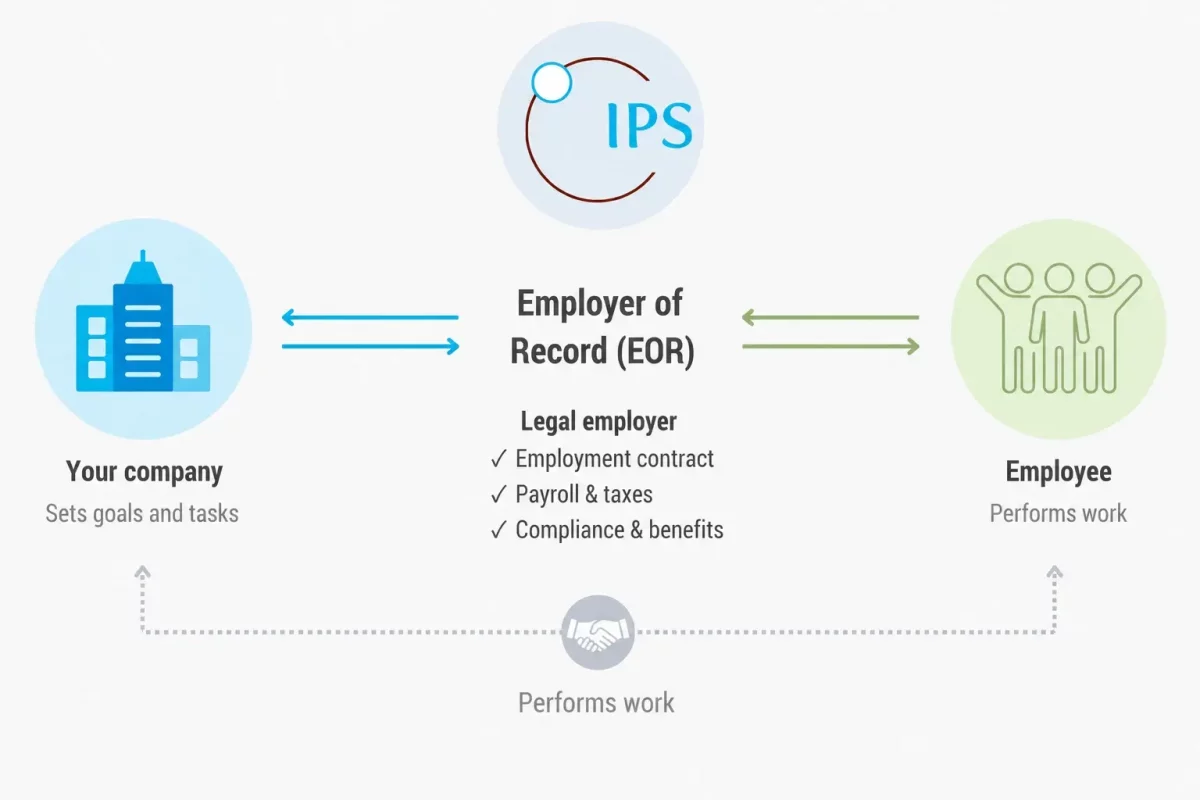
An Employer of Record (EOR) is a service provider that officially employs staff on behalf of a company. While the client company manages day-to-day work, the Employer of Record takes on all legal and administrative employer obligations.

Looking for an Employer of Record provider? Find all the information about our EOR service here.

How Does an Employer of Record Work?

An Employer of Record (EOR) takes on the legal employment of a staff member in the target country. The company remains responsible for day-to-day management, while the Employer of Record handles the employment contract, payroll, taxes, social security, and compliance with local labor law. This allows companies to hire international staff without having to set up their own local entity.

An Employer of Record acts as the legal employer of the staff member. For the employee, day-to-day work usually changes very little: they continue working for the company, receive their tasks from its managers, and remain part of the team. Legally, however, the employment relationship exists between the employee and the Employer of Record.

If a company wants to employ staff in a country without setting up its own entity there, an Employer of Record takes on all the labor-law obligations of the local employer. This includes, among other things, drafting the employment contract, registering with social security authorities, monthly payroll, tax payments, and compliance with statutory notice periods and labor-law regulations.

The company itself focuses on day-to-day operations. It manages the recruiting process, decides on hires, defines tasks, goals and salary, and directs the employee’s daily work. The Employer of Record ensures that this employment is implemented in a legally compliant way in the respective country.

How an Employer of Record Works, Step by Step

  • Select the employee
    The company finds a suitable candidate in the target country, or wants to locally hire an existing freelancer or employee.
  • Draft the local employment contract
    The Employer of Record drafts an employment contract in line with the applicable labor-law regulations of the respective country.
  • Take on legal employment
    The Employer of Record becomes the official employer and assumes all statutory employer obligations.
  • Manage payroll and social security
    Salaries are paid on time, taxes are remitted, and social security contributions are calculated according to local legislation.
  • Deploy the employee within the company
    Although the Employer of Record is the legal employer, the employee works exclusively for the client company and is managed there professionally.

In short:
An Employer of Record separates legal employment from operational collaboration. While the EOR takes on the employer obligations, the company remains responsible for management, projects, and the employee’s day-to-day work.

Want to know if IPS fits your project?

Tell us the country, role, and start date – we’ll check the simplest path.

Just call: +49 2173 2039568
or send us an email!

Send Email

When Does an Employer of Record Make Sense?

An Employer of Record makes sense when companies want to hire staff abroad without setting up their own entity in the respective country. The model is particularly useful for international expansion, remote hiring, project-based hires, or when local employment contracts, payroll and compliance need to be implemented in a legally compliant way.

An Employer of Record is particularly useful when a company wants to employ staff in a country where it has not yet set up its own company or entity. In this case, the EOR takes on the legal employment of the staff member in the target country.

This allows the company to hire international talent without first having to build local company structures, review labor-law requirements, or set up its own payroll processes.

When companies want to test new markets, an Employer of Record can significantly simplify entry. Instead of setting up a subsidiary right away, a single employee or a small team can initially be employed locally.

This makes it possible to check whether a market makes strategic, economic and organizational sense before larger investments are made in local structures.

An Employer of Record is also suitable when a company wants to employ international remote staff on a long-term basis. This applies especially when the employee lives permanently in another country and needs to be employed there in a legally correct way.

In this case, the EOR takes on the employment contract, payroll, taxes, social security, and local labor-law requirements.

For time-limited projects, an Employer of Record can help deploy staff abroad quickly and in a legally compliant way. This is especially relevant when local expertise is needed but no permanent entity is planned.

Once the project is complete, the employment relationship can be ended or adjusted in accordance with local statutory requirements.

An Employer of Record makes sense when international hires need to be implemented quickly. Setting up a local entity can take several weeks or months, depending on the country.

Via an EOR, legal employment can often start much faster, since existing local structures, employment contract templates and payroll processes are used.

An Employer of Record makes sense when companies cannot or do not want to handle a country’s labor-law, tax and social security requirements themselves.

The EOR ensures that the employment contract, payroll, employer obligations and local regulations are correctly implemented.

Startups and scaleups often use Employer-of-Record models to quickly hire international talent without building complex foreign entities at an early stage.

The model reduces administrative hurdles and makes it possible to flexibly test new countries before long-term structures are put in place.

In short:
An Employer of Record always makes sense when companies want to employ international staff in a legally compliant way, without becoming the legal employer in the target country themselves or setting up their own entity.

What Tasks Does an Employer of Record Handle?

Before Hiring

01 Employment Contract

The Employer of Record drafts a legally compliant employment contract in accordance with the statutory requirements of the target country. This takes into account compensation, working hours, vacation, notice periods and other labor-law requirements. This creates a legally secure employment relationship without the company needing to know local labor law itself.

02 Onboarding & Authority Registration

Before work begins, the Employer of Record handles the administrative preparations for the new employee. Depending on the country, this includes registrations with authorities, social security bodies, and local payroll systems. This allows the employee to start on time and in a legally compliant way.

During Employment

03 Payroll & Salary Processing

The Employer of Record calculates the monthly compensation, prepares the payslip, and ensures timely payment. At the same time, taxes and social security contributions are correctly remitted in accordance with local legislation.

04 Labor Law & Compliance

Throughout the entire employment period, the Employer of Record ensures that all labor-law requirements of the respective country are met. This includes legal changes, documentation obligations, and compliance with local employer obligations and compliance requirements.

05 Benefits & HR Administration

Depending on the country, the Employer of Record manages statutory and optional employee benefits. These include, for example, health insurance, pension models, or other benefits. The EOR also supports contract changes, sick leave, or other administrative HR processes.

Upon Departure

06 Offboarding

When the employment relationship ends, the Employer of Record handles the entire offboarding process in accordance with local labor law. This includes terminations, final settlements, deregistration with authorities, and all legally required documents. This ensures that the end of an employment relationship is also handled in a legally compliant way.

Frequently Asked Questions

An Employer of Record makes particular sense when you want to hire staff abroad without setting up an entity. The model is suitable for international expansion, remote hiring, project work, or fast market entry into new countries.

An Employer of Record takes on all legal employer obligations. This includes, among other things:

  • Drafting legally compliant employment contracts
  • Registration with authorities
  • Payroll and salary processing
  • Tax and social security administration
  • Compliance with local labor laws
  • Management of benefits
  • Offboarding and termination processes

Yes. The Employer of Record is the legal employer in the respective country. However, your company remains responsible for professional management, goal-setting, and the employee’s day-to-day work.

Whether an Employer of Record is cheaper depends on your expansion strategy. For individual employees or small teams, an EOR is usually more cost-effective than setting up and managing your own company. With a larger number of employees, a local entity can be worthwhile in the long run.

The Employer of Record takes on the statutory employer obligations in the target country. However, your company remains responsible for professional management and the operational deployment of the employee. The exact distribution of liability depends on the contractual agreements.

Yes. Many companies use an Employer of Record as a transitional solution. Once market entry has become established, employees can often be transferred to a newly founded local entity.