Professional Employer Organization (PEO): Definition, Benefits, Costs, and How It Works

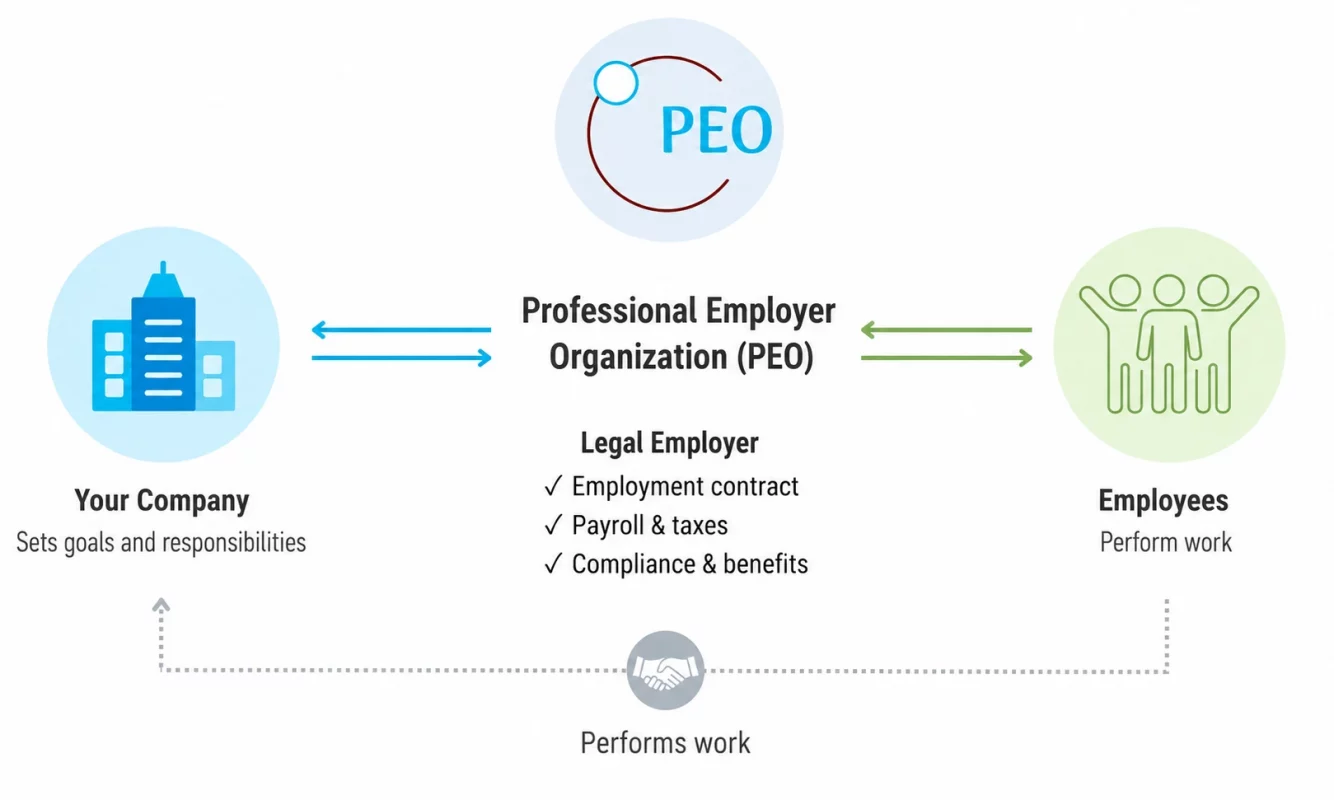
A Professional Employer Organization, or PEO, helps companies manage employees abroad. Unlike an Employer of Record, the company itself remains the legal employer. The PEO takes on defined tasks around payroll, HR administration, benefits, and compliance.

In this guide, you’ll learn how the PEO model works, when it makes sense, and which tasks a PEO provider can take on.

EOR Vertrag

Professional Employer Organization – Explained Simply

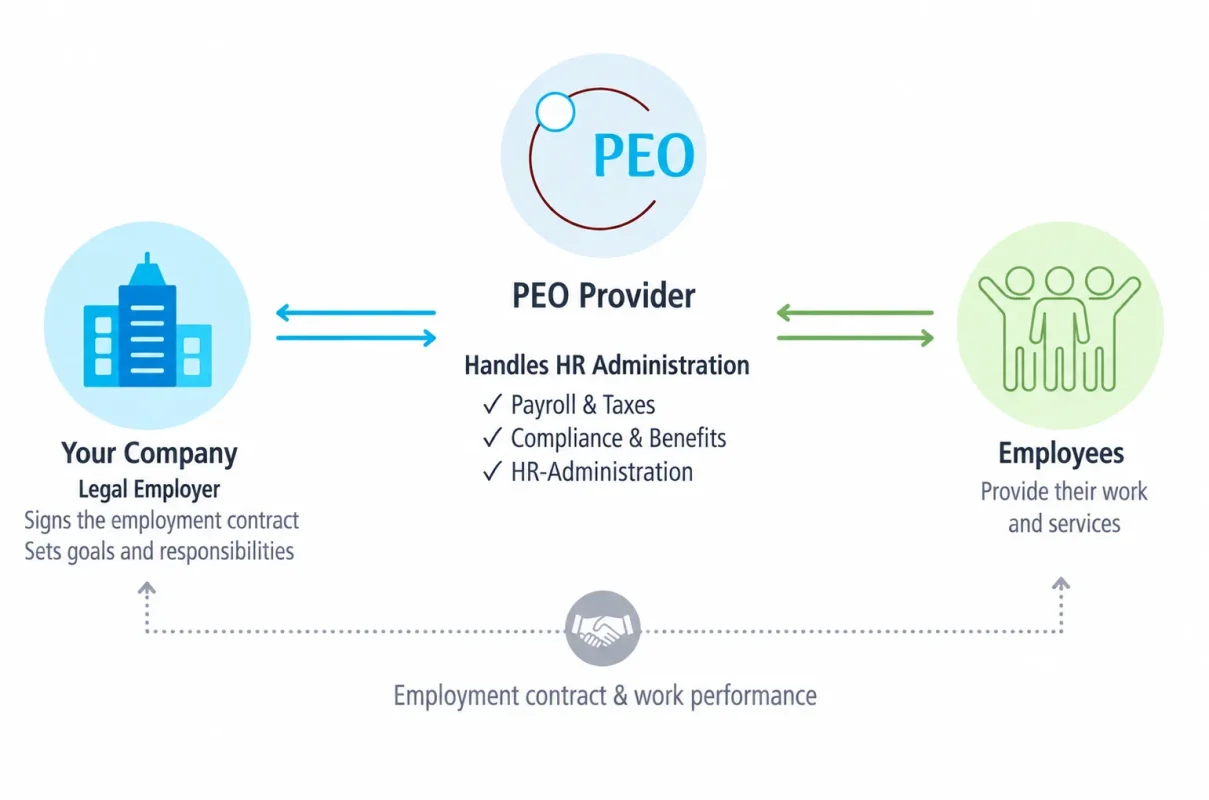
A Professional Employer Organization is an external HR provider that supports companies with administrative employer tasks. The company remains the legal employer and retains full leadership and control over its employees.

The PEO takes on agreed-upon tasks such as payroll processing, HR administration, benefits, filings, and support with labor law requirements.

Looking for a Professional Employer Organization? Find everything you need to know about our PEO service here.

How Does a Professional Employer Organization Work?

A Professional Employer Organization helps companies employ staff abroad and outsource the related administrative, legal, and payroll tasks. The specific scope of services is agreed individually between the company and the PEO provider.

Depending on the model, the PEO handles tasks such as local hiring, payroll processing, remittance of payroll taxes and social security contributions, as well as benefits administration and other HR processes. Throughout, the applicable labor, tax, and social security requirements of the country of employment are taken into account.

The company itself continues to direct the employee’s day-to-day work. Tasks, goals, projects, and instructions are still set by the client company, while the PEO handles the formal and administrative processes in the background.

Mitarbeiter-Innen in einem anderen Land einstellen

This allows a company to employ international staff without having to build and run all of the local HR, payroll, and compliance infrastructure itself. At the same time, it gains access to local points of contact, standardized processes, and an international infrastructure for HR administration and payroll.

How a Professional Employer Organization Works, Step by Step

  • Choose the employee and target country
    The company selects a suitable candidate and determines which country the employment will take place in.
  • Agree on the scope of services with the PEO
    The company and the PEO agree on which tasks will be handled. This often includes hiring, payroll, payroll tax, social security contributions, retirement benefits, and additional employee benefits.
  • Prepare local hiring
    The PEO organizes the formal requirements for employment, taking into account the labor, tax, and social security regulations of the target country.
  • Handle payroll and HR administration
    The PEO takes care of ongoing payroll processing, contributions, insurance, and other administrative tasks related to the employee.
  • Deploy the employee within the company
    Day-to-day management and technical direction remain with the client company. Tasks, projects, and work instructions continue to come directly from the company.

In short:
A Professional Employer Organization takes on the formal, administrative, and payroll-related tasks of international employment. The company focuses on the operational leadership of its employees, while the PEO handles the country-specific processes in the background.

Want to know if IPS is the right fit for your plans?

Tell us the country, role, and start date — we’ll check the simplest path forward.

Just give us a call: +49 2173 2039568
or send us an email!

Send Email

When Does a Professional Employer Organization Make Sense?

A Professional Employer Organization makes sense when companies want to employ staff abroad without fully building out the necessary HR, payroll, and administrative processes themselves. The model is especially useful for international expansion, fast hiring needs, limited internal HR resources, or when local legal and accounting requirements need to be handled reliably.

A Professional Employer Organization is especially useful when a company wants to employ staff in a new market but doesn’t yet have its own entity or permanent establishment there. The PEO provides the necessary local infrastructure and handles the formal aspects of employment in line with that country’s requirements.

This allows the company to enter new markets and deploy staff locally without first having to set up its own legal entity, build local payroll processes, or become an expert in every applicable labor, tax, and social security requirement. Technical and operational direction of the employee stays with the company.

When companies want to enter new markets, a Professional Employer Organization can significantly speed up market entry. The PEO’s existing international infrastructure makes it possible to hire, employ, and pay staff in the target country without first setting up your own HR, payroll, and administrative structures.

This lets a company start flexibly with a single employee or a small team and test whether the market makes strategic and economic sense. While the PEO handles the country-specific legal, tax, and administrative requirements, operational leadership of the employees stays with the company.

A Professional Employer Organization is a good fit when a company wants to employ remote staff in another country on an ongoing basis, without operating its own legal entity there. The PEO provides the local employment and administrative infrastructure and handles the formal aspects of hiring, payroll, taxes, social security, and other country-specific requirements.

Technical leadership stays with the company: tasks, projects, and work instructions continue to come directly from the client. The PEO handles the legal and accounting administration of the employment in the target country in the background.

For time-limited projects, a Professional Employer Organization makes it possible to hire the needed specialists abroad quickly and in full compliance. This is especially useful when a project requires local expertise, but you don’t want to establish your own permanent establishment or long-term HR structure in the target country.

The PEO handles the formal employment relationship as well as the country-specific tasks around contracts, payroll, taxes, social security, and HR administration. The company retains operational leadership and continues to manage tasks, projects, and work instructions itself. Once the project ends, the employment relationship can be terminated or adjusted to future needs in line with local legal requirements.

A Professional Employer Organization makes sense when international hires need to happen on a tight timeline. Rather than first building a local entity, payroll structure, and HR administration, companies can rely on the PEO’s existing infrastructure and established local processes.

This often makes it possible to hire, employ, and pay staff in the target country significantly faster. The PEO handles the formal, administrative, and payroll-related tasks, while the company retains technical leadership and day-to-day management.

A Professional Employer Organization is a good option when companies can’t — or don’t want to — fully manage a target country’s labor, tax, and social security requirements in-house. With international employment in particular, requirements around employment contracts, payroll, social contributions, benefits, and reporting obligations vary from country to country.

The PEO draws on local expertise and established processes to account for these requirements when hiring and managing employees on an ongoing basis. At the same time, operational leadership stays with the company, while the PEO handles the agreed legal, accounting, and administrative tasks in the background.

In short:
A Professional Employer Organization is most valuable for companies that already have their own entity or employer structure in the target country. In this model, the company itself remains the legal employer of its staff, while the PEO takes on defined tasks around HR, payroll, administration, and compliance. Operational and technical leadership also stay with the company.

What Tasks Does a Professional Employer Organization Handle?

Before Hiring

01 Employment Contract and Terms of Employment

The PEO helps prepare legally compliant employment contracts and terms of employment in line with the requirements of the relevant country. This can include compensation, working hours, vacation, notice periods, benefits, and other labor law requirements.

The employment contract is entered into between the company and the employee. The company remains the legal employer and makes the key employment-related decisions. The PEO contributes local expertise and helps set up the employment relationship in a way that’s administratively sound and practical.

02 Onboarding and Registration with Authorities

Before the employee’s start date, the PEO helps with the administrative preparations. Depending on the target country and the agreed scope of services, this can include setup in payroll and HR systems, registration with social security bodies and authorities, and collection of the required personal data.

The PEO coordinates these processes and supports onboarding, while the company remains the legal employer and handles the employee’s technical and operational integration.

During Employment

03 Payroll & Salary Processing

The PEO handles ongoing payroll processing in line with the requirements of the relevant country. Depending on the agreed scope of services, this includes calculating compensation, generating payslips, and preparing or processing payroll tax and social security payments.

The company remains the legal employer. The PEO provides the necessary payroll processes and local expertise so that salaries, contributions, and filings are processed on time and in a transparent, traceable way. Our previous PEO page specifically named payroll accounting, payroll tax payments, and health and social security contributions as typical service areas.

04 Local Requirements & Compliance Support

During employment, the PEO helps the company implement local labor, tax, and social security requirements administratively. This can include statutory filings, documentation obligations, changes to employment terms, and coordination with local authorities.

Legal employer responsibility remains with the company. The PEO supports the agreed processes with country-specific expertise and helps account for legal changes in payroll and HR administration. Our previous PEO page also highlighted the handling of country-specific legal and accounting requirements as a core service.

05 Benefits & HR Administration

The PEO can administer both statutory and supplementary employee benefits. Depending on the country and the agreement, this can include health insurance, retirement benefits, other perks, and reflecting these correctly in payroll.

The PEO also supports recurring HR processes such as updates to employee data, certificates, absences, and compensation adjustments. The company remains the employer and makes HR-related decisions; the PEO handles the agreed administrative execution. Benefits and retirement provisions were also explicitly listed as possible service components on our previous PEO page.

At Offboarding

06 Offboarding & Final Settlement

When an employment relationship ends, the PEO helps the company handle the administrative side of the departure. This can include the final pay settlement, calculating any outstanding compensation, deregistering the employee from social security and other bodies, and preparing the required payroll and HR documents.

The company remains the legal employer and makes the decision to end the employment relationship, and is therefore also responsible for complying with local notice requirements. The PEO supports the process, within the agreed scope of services, with local expertise and ensures the payroll-related and administrative steps are carried out correctly. Our previous PEO page specifically described payroll, HR administration, and the handling of country-specific legal and accounting requirements as part of the service.

Frequently Asked Questions

A Professional Employer Organization, or PEO, is a provider that helps companies with international HR, payroll, and administrative processes. The PEO takes on agreed-upon tasks such as payroll processing, administration of social contributions and benefits, and support with local compliance requirements.

The company remains the legal employer of its staff and retains technical and operational leadership. The PEO complements the existing employer structure with local expertise and administrative processes.

To start, the company and the PEO jointly decide which tasks will be outsourced. The PEO is then integrated into the existing HR and payroll processes and takes on the agreed administrative services.

This can include, for example, payroll processing, tax and social security filings, benefits, HR documents, and coordination with local partners. HR decisions, work instructions, and day-to-day operations remain with the company.

Under the PEO model described here, the client company itself remains the legal employer. It enters into the employment contract with the employee, makes HR decisions, and carries employer responsibility.

The PEO supports the company with the agreed HR, payroll, and compliance processes, but does not automatically take on the legal employer role. This is exactly what distinguishes the model from an Employer of Record.

The specific scope of services is agreed individually. Typical services include payroll processing, handling payroll taxes and social security contributions, administering benefits and retirement provisions, and other HR administration tasks.

The PEO can also support local filings, documentation obligations, onboarding, final settlements, and implementation of country-specific requirements. Our previous PEO page specifically named hiring, payroll accounting, payroll tax, social security contributions, retirement provisions, and special employee benefits as possible service components.

With a PEO, the company remains the legal employer itself and uses the provider to support its existing employer structure. This typically requires the company to have its own entity or a suitable employer structure in the relevant country.

With an Employer of Record, by contrast, the EOR becomes the legal employer of the staff. The EOR model is therefore especially well suited to situations where a company doesn’t yet have its own entity in a country. In both models, technical leadership of the employees stays with the client company.

A PEO makes the most sense for companies that already have their own entities or employer structures in one or more countries but don’t want to run their local HR and payroll processes entirely in-house.

The model is especially relevant for growing international teams, multiple payroll countries, a lack of local HR expertise, or an overstretched HR department. The PEO can centrally coordinate administrative tasks while the company remains the legal employer and focuses on leadership, organization, and day-to-day operations.